Sample questions:
(There are more questions here.)
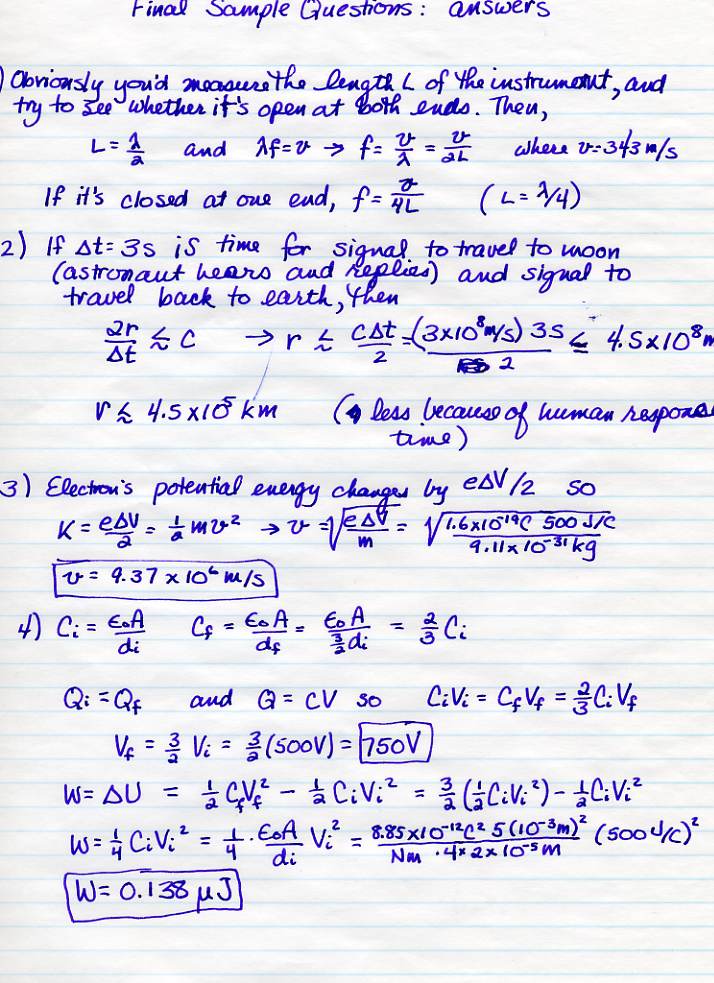
1) You shouldn't be too surprised to see a hands-on question, such as, here's a wind instrument. What is the lowest-pitched note that can be played on it?
2) A distressing aspect of the Apollo moon landings was the weird pace of conversations between the geeks at Mission Control in Houston and the geeks in the rocket ship orbiting the moon. Houston would ask a simple question (such as "How are you?") and there would be a delay of nearly three seconds before we heard the response. ("fine") Based on this information, how far away is the moon?
3) We have a parallel-plate capacitor (plates' area=5 square millimeters, separation=.02mm) charged up to a voltage of 500 V. An electron is momentarily motionless midway between the two plates. How fast is it going when it smacks into which plate, or doesn't it do that?
4) Suppose we disconnect that capacitor in the previous problem from its power source, and then move the two plates to a separation of .03 mm. How much work must we do? What is the voltage now? (answers for 1-4)
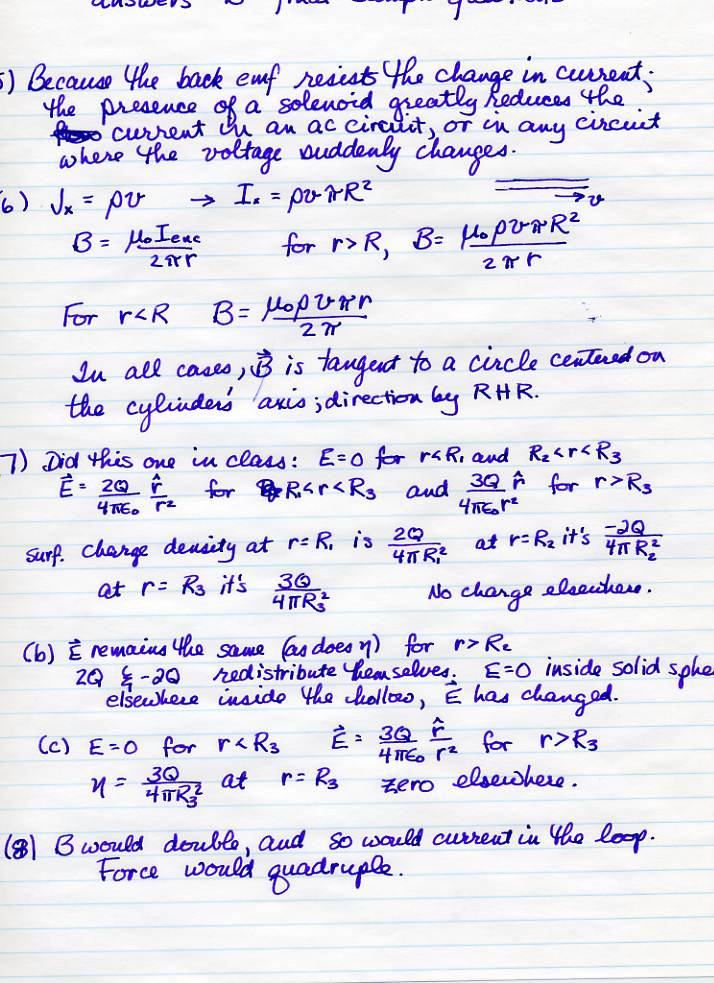
5) Solenoids are sometimes called "chokes" when they are included in an ac circuit. Why is this a fairly descriptive name for them?
6) A really long cylinder of uniform charge density rho and radius R travels in the +x direction at a speed v. What is the resulting magnetic field everywhere?
7) Suppose we have a metal sphere of radius R1, centered inside a spherical metal shell of inner radius R2 and outer radius R3. A charge of 2Q has been placed on the solid sphere, and a charge of Q on the shell.
(a) What are the total charge and the charge densities on each surface, and the electric field everywhere?
(b) Suppose the solid sphere is now moved so that it's no longer concentric with the shell, but without touching the shell. Which of your answers to (a) (if any) change?
(c) Now suppose the solid sphere is moved farther, so that it touches the inner surface of the shell. Now which answers change? Answer any of the questions in part (a) that you can now answer.
8) In class we ran an ac current through a solenoid, and made a metal ring float. There must have been an upward magnetic force on the ring. If we were to double the current through the solenoid, by what factor would the magnetic force on the ring change? (answers for 5-8)
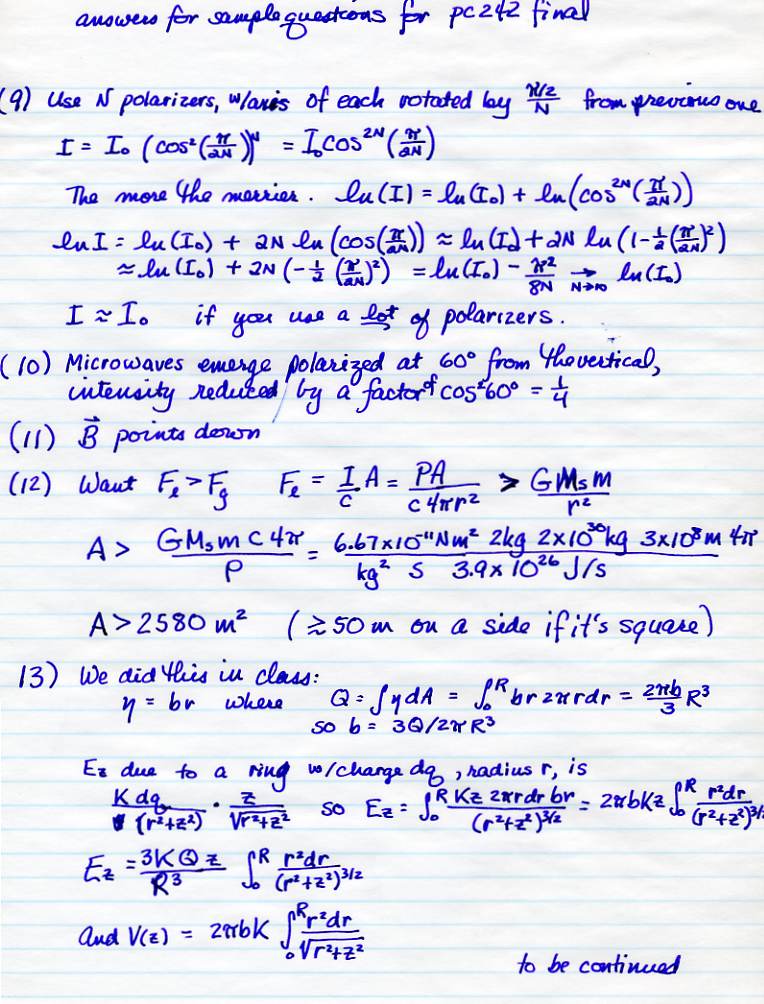
9) We begin with vertically polarized light of intensity I-nought, and we'd like to convert it into horizontally polarized light of the most intensity we can get. We have a supply of very nice polarizers. How many of them ought we to use, in what configuration, to produce what intensity?
10) You remember working with the microwave generators in lab, and concluding that the wavelength of the microwaves was ten or twenty centimeters. We sometimes use with these generators another device, which kind of resembles a hot dog grill - it's a square frame, holding parallel bars, spaced about 1.5-2 cm apart. When we place this device in front of one of the generators, with the plane of the grill parallel to the front face of the generator but with the bars tilted at 30 degrees from the vertical, what does it do to the microwaves being emitted from the generator?
11) Suppose a beam of linearly polarized radio waves is traveling north, and at this moment the associated electric field at your location is pointing east. In what direction is the associated magnetic field pointed, or can't you be sure?
12) How big a sail must we attach to a 2 kg space probe, if we want the sun to push the probe out of the solar system? (answers to 9-12, and part of 13)
13) Given a disk of radius R and total charge Q, distributed so that the surface charge density increases linearly with distance from the center of the disk, what is the electric field at a height z above the center of the disk? What about the electric potential at that height? Are your two answers consistent with each other? Do your answers give you the expected result for z>>R? What about for small z? (this is, I think, kind of tricky)